European Cities Brace for Protests as Milan Deploys Troops
At a Glance
Italy is deploying 500 additional soldiers to Milan ahead of planned demonstrations following last weekend’s looting and clashes.
Authorities are tightening security in Milan and Rome amid concerns about further violence.
Protests across Europe address a range of issues, including education, corruption, housing costs, and public pensions.
Demonstrations are also expected in Albania, Spain, and Portugal.
Several European cities are preparing for demonstrations on Saturday as authorities increase security following recent unrest. In Milan, Italy, the government is deploying 500 additional soldiers after looting and clashes with police last weekend.
Key Statements and Focus Area
Security Reinforcement: “The additional troops will support hundreds of soldiers already stationed in Milan, alongside about 5,000 police and other law enforcement personnel.” — Italian government and local authorities.
Police Capacity: “Soldiers could provide immediate support but would not resolve police staffing shortages, as managing demonstrations requires specialized training.” — Fsp police union chief, Valter Mazzetti
Social Exclusion: “Many young people increasingly lack a sense of belonging and prospects for the future. Part of our society feels excluded amid social and economic inequalities.” — Milan welfare councillor Lamberto Bertolé.
Focus Area: Authorities across Europe are preparing for demonstrations driven by different social and political grievances while seeking to prevent further clashes.
Milan Increases Security After Looting
The additional soldiers will support security operations across Milan, where authorities are using drone surveillance, railway station checks, rapid-response units, and online monitoring to identify potential calls for violence. Security measures are expected to extend beyond the city center amid concerns that protesters could move into other neighborhoods.
Last weekend, groups broke into shops and stole goods, including sneakers, sportswear, and sporting equipment, on streets near the central Duomo square.
Police said around 2,000 young people were involved in the violence and looting. Officers arrested 45 people over two days, including 34 minors. Authorities said many of those involved were naturalized or second-generation Italians, alongside foreign nationals.
Defense Minister Guido Crosetto said the soldiers lacked some equipment available to police during public-order operations. He said their authorization to use plastic restraint ties was limited to areas around train stations and that they were not permitted to carry pepper spray or tasers.
Rome Prepares for Demonstrations
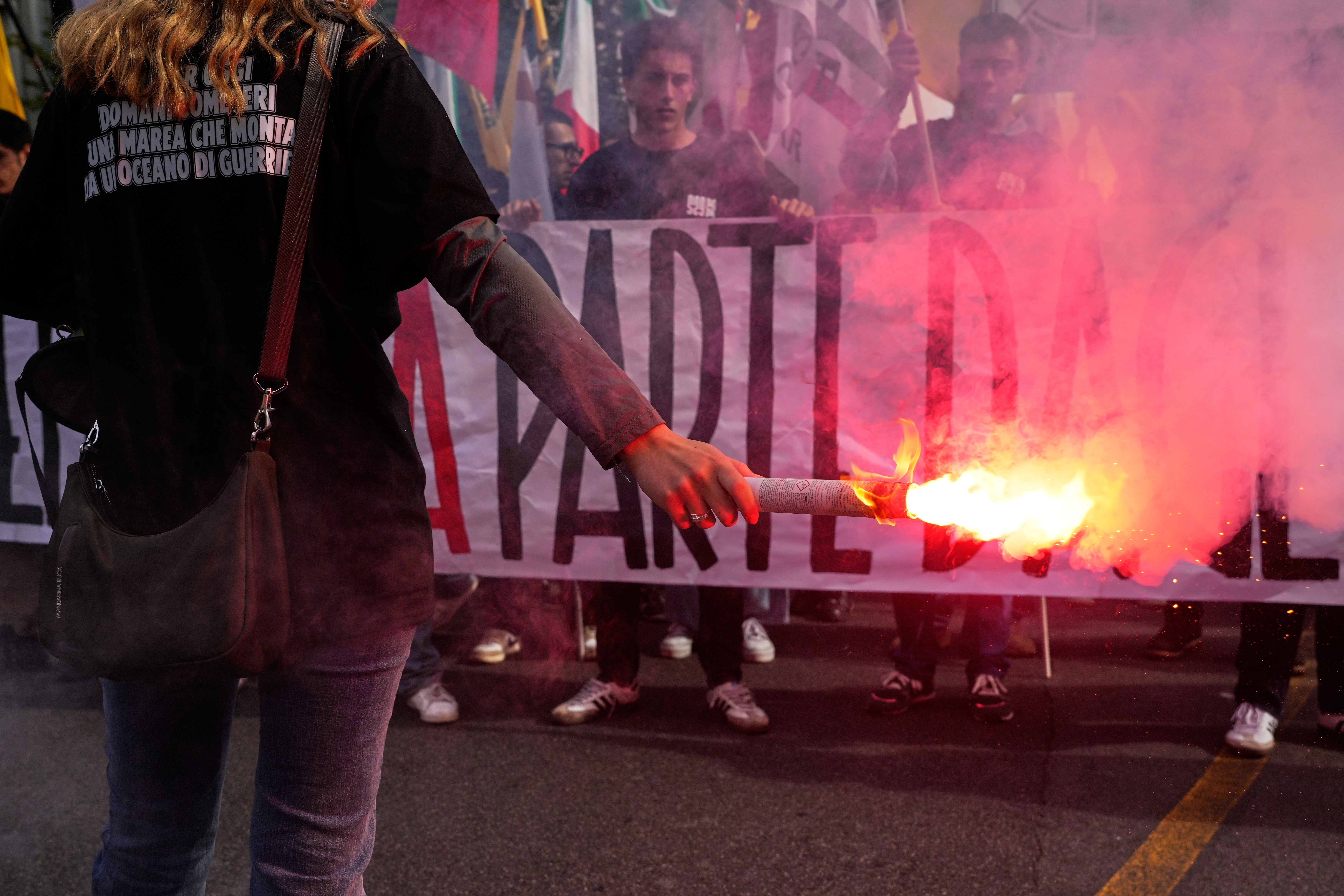
Authorities in Rome have increased security around luxury shopping streets, the Circus Maximus, and Piazza del Popolo ahead of planned demonstrations, including one organized by right-wing students.
An anti-war march is scheduled to begin in the early afternoon at Piazza della Repubblica. Organizers have urged participants to keep their faces uncovered and their hands visible, seeking to distance the demonstration from potential violence.
Demonstrations have also been called in at least seven other Italian cities. The newly formed October 17 Movement is among the main groups organizing protests, alongside student federations, grassroots trade unions, and anti-war coalitions.
Albania Sees Continued Unrest
In Tirana, protests have continued for more than a week, with demonstrators throwing rocks, flares, firebombs, and fireworks at police. Officers have responded with batons, water cannons, and tear gas.
High school and university students are demanding lower tuition fees, greater state investment in education, and action against corruption in the education system. Their demonstrations have joined a broader anti-government movement calling for the resignation of Socialist Prime Minister Edi Rama.
Housing and Pensions Drive Protests in Spain and Portugal
In Madrid, retirees and other demonstrators are expected to protest against changes to public pensions ahead of next month’s snap election. Prime Minister Pedro Sánchez’s Socialist Party has criticized the conservative Popular Party over suggestions about privatizing public pensions.
Housing affordability has also fueled protests across Spain, where rising rents and home prices have placed pressure on residents. Campaigners point to housing shortages associated with population growth, tourism, immigration, and the expansion of short-term rentals. The eviction of an 87-year-old woman from her rented Madrid apartment in September triggered large demonstrations. A tent camp protesting the housing crisis has remained in Puerta del Sol for almost a month.
In Lisbon, demonstrators are expected to march for more affordable housing. Protesters oppose measures proposed by Prime Minister Luis Montenegro’s government that would ease limits on annual rent increases and make it easier to evict tenants who fail to pay.
Montenegro has defended the measures as a way to strengthen trust between landlords and tenants and encourage the rental market. Protesters argue that the changes could leave tenants more vulnerable.
FYI
Protests across Europe reflect different national concerns rather than a single coordinated movement. Demonstrations described in the source range from public-order and anti-government protests to campaigns over education, housing affordability, and pension policy.
Dive Deeper: Handpicked Stories for You
Follow Channel8 for continuous updates:
French Student Protests Intensify Scrutiny of Police Tactics
Milan Protest Turns Violent as Police Detain Demonstrators
Albania Protests Turn Violent as Opposition Demands Rama Resignation
.jpg)
.jfif)